Old Fashioned Phrases: 25 Vintage Sayings and True Origins
English speakers use colorful vintage idioms every day without considering their historical origins. We tell restless children to...
Explore historical word origins, debunked linguistic myths, verified quotations, and bilingual language facts, traced directly to primary archival manuscripts.
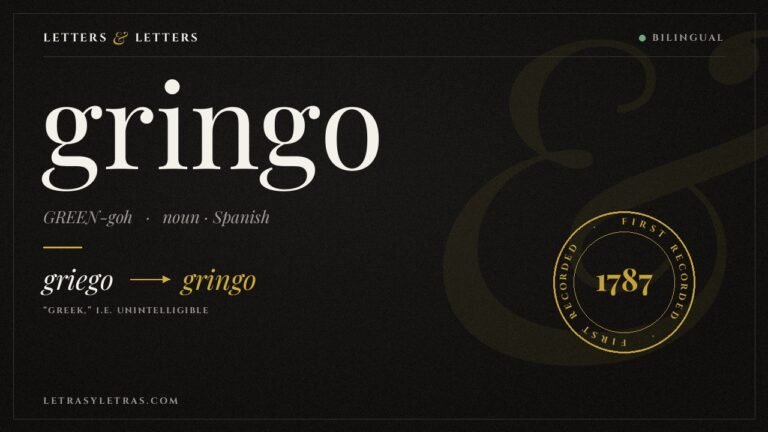
Popular folklore claims the word came from American soldiers wearing green coats in the 1846 Mexican War. In reality, the word was recorded in Madrid dictionaries in 1787 as an alteration of griego (Greek) meaning foreign speech.
Every guide is cross-examined against primary manuscripts, etymological corpora, and historical dictionaries.
Trace ancient Proto-Indo-European roots, Latin evolutions, Norman French borrowings, and surprising historical semantic shifts.
Explore 43 Word Origins →Discover the naval deck commands, medieval courts, and Victorian theater traditions that birthed our everyday sayings.
Explore 34 Idioms →Curated collections of timeless philosophical wisdom from Voltaire to Churchill, with apocryphal and fake quotes debunked.
Explore Verified Quotes →Explore Spanish and English linguistic crossovers, false cognates, phonetic mutations, and shared classical heritage.
Explore Bilingual Archive →The internet loves colorful word origins. Most are complete fiction. Here is the historical truth with the primary source evidence.
Not American soldiers in green uniforms. It is an 18th-century Spanish phonetic shift from griego (Greek), meaning foreign speech.
Roman sculptors did not conceal cracked marble with wax ("sine cera"). Latin sincerus derives from PIE *sem- and *ker-, meaning "of one growth" and pure.
Seasick sailors on 19th-century sailing vessels were sent below deck to the leeward side ("under the weather rail") where crashing waves were milder.
Captain Charles Boycott did not invent the tactic; he was its target. In 1880, Irish Land League tenants instituted peaceful social isolation against him.
Fresh linguistic investigations published weekly by Alan Sledge and the Letters & Letters editorial desk.
English speakers use colorful vintage idioms every day without considering their historical origins. We tell restless children to...
Few slang words in the global lexicon carry as much cultural weight as the term gringo. Travelers hear...
Every December, millions of households exchange festive greetings and decorate evergreen trees. We sing familiar carols and wrap...
The pursuit of flawless performance has haunted artists, thinkers, and builders for thousands of years. We polish our...
Morning light filters across porcelain diner counters as steam drifts from thick ceramic mugs. Waitresses refill cups without...
A piercing acoustic wail cuts through heavy city traffic. Ambulance drivers clear intersections as flashing red lights reflect...
Why thousands of readers, writers, and language researchers trust Letters & Letters for linguistic history.
Every origin is cross-referenced against the Oxford English Dictionary (OED), Real Academia Española, and 18th-century print dictionaries.
If a colorful backstory cannot be validated through contemporary print records, we classify and debunk it as folklore.
Interactive quote and origin cards generate instant copyable APA 7th and MLA 9th edition academic citations.